
The business of creativity
Hourly vs. Fixed Pricing: What Should Designers Actually Charge?
Charge hourly when the scope is uncertain. For a defined project, quote a fee that accounts for time, usage rights, expenses, and revisions. Seven creatives weigh in, including sports illustrator Rob Zilla, who explains why creative thinking is hard to put on a clock.
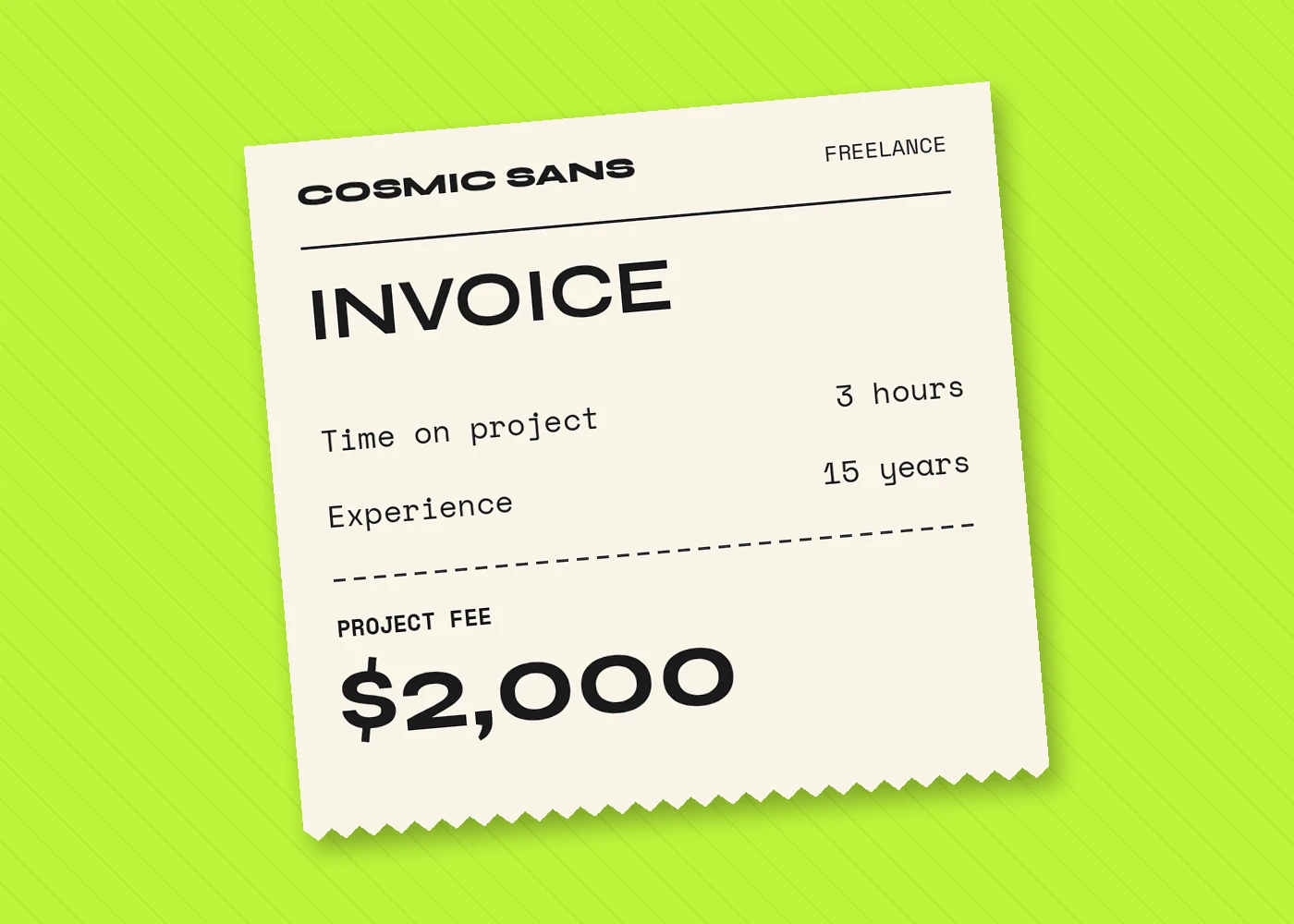
Imagine spending fifteen years becoming an exceptional designer.
You've studied your craft, developed your style, worked with countless clients, and learned how to solve creative problems faster than you ever thought possible.
Then one day, a client hires you to design something.
You deliver exactly what they wanted. They're thrilled.
Until they ask the question.
How long did that take you?
You tell them three hours.
And suddenly, that $2,000 invoice looks a little excessive to them.
But here's the thing.
Are they paying for the three hours it took you to complete the project, or the fifteen years it took you to become capable of completing it in three hours?
It's one of the oldest debates in the creative industry.
Hourly pricing versus fixed project fees.
And after speaking with artists, designers, and creative professionals on the Cosmic Sans Podcast, I've realized something.
We're probably asking the wrong question.
The Problem With Charging by the Hour
During my conversation with sports illustrator Rob Zilla, something he said really stuck with me.
We were discussing the creative process, including how ideas develop and occasionally find their way into projects years after they were originally conceived.
Rob explained why he doesn't bill his clients hourly.
"You'll be paying me to think. And I think nonstop."
I love this perspective.
Because when does creative work actually begin?
Is it when you open Photoshop? When you start sketching? When you sit down at your desk?
Or does it begin when you're driving to the grocery store and suddenly come up with the perfect concept?
For many creatives, the thinking never really stops.
Rob explained that he prefers flat-rate pricing, taking the client's budget and the intended usage of the artwork into consideration.
And that makes a lot of sense.
If a designer creates an incredible logo in two hours, should they earn less than another designer who takes twenty?
If anything, the designer who worked faster might be bringing more experience to the table.
The faster you become at your craft, the less hourly pricing can reward that efficiency.
Which is a pretty strange incentive when you think about it.
Imagine telling a client that you've become so good at what you do that you'll now be charging them less.
Congratulations on your efficiency. Here's your pay cut.
Of course, that doesn't mean hourly pricing is fundamentally flawed.
It just means time isn't always the best measurement of creative value.
But Fixed Pricing Has Its Own Problems
Here's where things get interesting.
Not every creative project can be neatly packaged into a single price.
When I spoke with Arabela Espinoza and Elle Mott of Weekend Creative, we explored the business side of running a commercial photography and creative studio.
Elle explained that clients often want straightforward packages and price lists.
But the reality is much more complicated.
One project might require a studio, several models, a stylist, and extensive retouching.
Another might involve a single product photographed in a relatively simple environment.
Even when the final deliverables look similar, the work involved can be dramatically different.
Elle described their approach to pricing around three factors:
Time, value, and additional expenses.
Time includes the work required to plan, produce, photograph, and retouch the project.
Value considers how the client intends to use the images, including licensing.
Additional expenses cover things like studio rentals, props, contractors, and other production costs.
That distinction is important.
Because a fixed project fee doesn't magically eliminate the time and resources required to complete the work.
It simply changes how those costs are presented to the client.
And then there's the dreaded scope creep.
You know how it goes.
A client hires you to design a logo.
Then they need some social graphics.
Then a presentation template.
Then a slightly different version for another department.
And before you know it, you're designing their entire brand identity for the price of a logo.
Weekend Creative handles this by making it clear that estimates can change as project requirements evolve.
That's a valuable lesson regardless of whether you're charging hourly or by the project.
A fixed fee should establish expectations, not create an unlimited subscription to your creativity.
You're Not Just Selling the Design
There's another piece of the pricing conversation that I think gets overlooked far too often.
Ownership.
When I interviewed illustrator Orlando Arocena, better known as Mexifunk, we spent time discussing contracts, licensing, and the business of commercial illustration.
Orlando shared something interesting about how he approaches certain projects.
"I supplied them a licensing estimate, and I supplied them something that's a total buyout."
Two different prices.
Potentially for the exact same artwork.
Why?
Because the client isn't necessarily purchasing the same rights.
Consider an illustration created for a small promotional campaign.
Maybe the client wants to use it on social media for six months.
Now imagine another client wants that same illustration for a global advertising campaign, printed merchandise, packaging, and exclusive use for years.
The artwork hasn't changed.
The time required to create it hasn't changed.
But what the client receives is dramatically different.
And that should be part of the pricing conversation.
Orlando explained that when clients request broader ownership through a buyout or work-for-hire arrangement, he considers the additional value they're acquiring.
He also thinks about his ability to showcase and reuse his own work in the future.
These aren't insignificant details.
For artists and illustrators, retaining certain rights can create opportunities long after the original project has been completed.
It's also why a simple hourly rate can be misleading.
You might be fairly compensated for creating an illustration while significantly undervaluing the rights you're giving away.
The hours tell you what it took to create something. They don't necessarily tell you what it's worth to the person buying it.
Sometimes the Price Isn't the Only Thing You Can Negotiate
One of my favorite conversations about creative pricing happened with illustrator Tyler Pate.
Tyler has worked across everything from commercial illustration to posters for major musicians.
Naturally, I wanted to know how he approaches pricing when someone like Paul McCartney comes calling.
His answer was refreshingly practical.
Every project is different.
Sometimes the client has a firm budget. Sometimes there's flexibility. And sometimes the opportunity itself is particularly meaningful.
Rather than treating negotiation as a simple yes-or-no decision, Tyler suggested responding with:
"This doesn't work, but what about this?"
Such a simple idea.
But it can completely change the conversation.
Tyler described situations where a budget couldn't increase, so he negotiated for additional artist-proof prints instead.
Those prints still had value to him, even if the original project fee remained unchanged.
He also considers timelines, existing commitments, and whether a project is personally exciting.
And I think there's something important in that.
Negotiation doesn't always have to mean demanding more money.
Sometimes it means reducing the scope, extending a deadline, changing deliverables, or finding another arrangement that makes sense for both parties.
That doesn't mean accepting every project for less than your usual rate.
It means understanding what matters to you and what flexibility actually exists.
Because sometimes the most productive response to an offer isn't yes or no.
It's what if?
Knowing Your Worth Is a Skill of Its Own
Pricing becomes even more complicated when you're still establishing yourself.
In my conversation with David Oku, he explained how working with an agent completely changed his understanding of the business side of illustration.
Before that experience, he was essentially charging whatever felt reasonable.
He later discovered he had been undervaluing his work, particularly when it came to licensing and royalties.
It's something we explored more deeply in You're Probably Charging Too Little for Your Creative Work.
But there's another perspective worth considering.
When I spoke with illustrator Deja Brown, we discussed the challenge of determining your value when you're relatively new to the industry.
Deja offered a reminder that I think more designers need to hear.
"They're reaching out to you for a reason. They see value in your work."
That's easy to forget when you're nervous about landing a project.
But Deja also emphasized the importance of being realistic about your experience and seeking advice from people further along in their careers.
In fact, she encouraged creatives to reach out to other designers and ask what they would charge for a similar project, and why.
Not necessarily to copy their rates.
But to understand how they arrived at those numbers.
Because pricing shouldn't be a complete guessing game.
And yet, for so many creatives, that's exactly what it becomes.
We spend years learning how to create things, but often very little time learning how to sell them.
So, Should Designers Charge Hourly or Per Project?
Here's where I've landed after all these conversations.
I don't think there's one pricing model that works for every creative or every project.
Hourly pricing makes sense when the scope is difficult to predict.
Think ongoing design support, consulting, exploratory work, or projects where requirements are constantly evolving.
It provides flexibility when you genuinely can't know how much work will be involved.
Fixed pricing makes sense when the outcome is clearly defined.
A brand identity, commissioned illustration, poster, or carefully scoped campaign can often benefit from an agreed project fee.
The client understands the cost.
The creative understands what they're responsible for delivering.
And the price doesn't automatically decrease simply because the designer has become more efficient.
But I think the most useful approach often combines elements of both.
Understand your hourly costs internally, even if you never show a client an hourly rate.
Estimate the time required, including the thinking, meetings, revisions, and all those little tasks that tend to disappear from invoices.
Consider the complexity, commercial usage, licensing, and any outside expenses.
Then determine what a fair project fee looks like.
And most importantly, establish what happens when the scope changes.
A fixed fee with clearly defined deliverables and paid additional work can offer predictability without ignoring the realities of creative production.
| Model | Best when | Biggest risk | How to protect yourself |
|---|---|---|---|
| Hourly | The scope is open, as in consulting or ongoing design support. | Getting faster can mean billing less for the same result. | Set a rate that reflects your experience. Agree on a weekly cap and check in before you reach it. |
| Fixed fee | You can name the deliverables, deadline, and number of revisions. | One more round of feedback turns into unpaid work. | Spell out what’s included and agree on a price for extras before starting them. |
| Hybrid | The main deliverable is clear, but follow-up requests may change. | Planning, meetings, and thinking time disappear from the estimate. | Estimate hours, expenses, and usage rights internally. Quote a project fee and an hourly rate for additional work. |
Incidentally, this is one of the reasons I built the Cosmic Sans freelance pricing calculator. It helps you work through your actual costs, estimate a project, account for licensing, and see what happens when a client requests another round of revisions.
It won't magically tell you what your creativity is worth.
But it can help you stop pulling numbers out of thin air.
Stop Selling Hours. Start Understanding Value.
There's something fascinating about the way we measure creative work.
We happily pay experienced professionals more because of their knowledge and expertise.
But when it comes to design, there's still a temptation to reduce everything to the number of hours someone spent moving pixels around.
And I think that misses the bigger picture.
Rob Zilla reminded me that creative thinking doesn't stop when you close your laptop.
Weekend Creative demonstrated why time, production costs, and licensing all deserve consideration.
Orlando Arocena highlighted the importance of understanding ownership.
Tyler Pate showed that negotiation can be more flexible than simply lowering your price.
And David Oku and Deja Brown reinforced how important confidence and business knowledge are to building a sustainable creative career.
Different perspectives.
Different approaches.
But they all point toward the same broader lesson.
You're not just charging for the time it takes to create something. You're charging for the knowledge, expertise, decisions, and value behind it.
Whether that ends up on an hourly invoice or a fixed-price proposal is only part of the equation.
So the next time a client asks how long a design took, perhaps the more interesting question is what went into making it possible.
And what they'll be able to do with it.
Keep the conversation going
This Story brings together perspectives from several conversations on the Cosmic Sans Podcast, exploring the business realities behind creative careers.
From Rob Zilla's approach to flat-rate illustration to Orlando Arocena's thoughts on licensing and Tyler Pate's negotiation strategies, there's a lot more to creative work than the final deliverable.
You can explore their conversations, along with dozens of others, in the Cosmic Sans episode archive.